
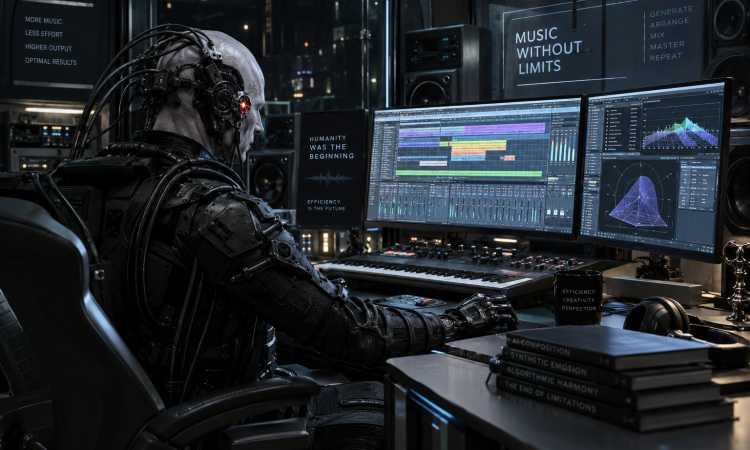
 When you look at the dark side, careful you must be. For the dark side looks back. — Yoda
Master Yoda was right. The temptations of the dark side are great, and fear is the true enemy. And in this case, the dark side really does look back.
This is the story of my journey into the realm of generative AI music and back out again. It was a personal challenge worthy of a Jedi test.
Chapter 1 – Good Intentions
In my quest to make music my full-time job, I became interested in the idea of monetizing long videos that seem to get millions of views. I wanted to know if these were several shorter pieces strung together, or long highly-repetitive patterns, or something else. What I found was that all of these approaches are in play.
During this research, I came across a video explaining how easy it is to make your own channel with these kinds of videos, all using AI so you can make them very fast–and therefore get rich even more quickly. While that idea was clearly a red flag, I decided to try the process to see how it worked and if there was any truth to be found. I did find some, but not what I expected.
Chapter 2 – Curiosity
The instructions were simple: Tell one AI to make a prompt that a different AI would use to make the music, so I did that. I told the first AI to create a prompt for a piece of New Age meditation music with a nighttime forest motif. In less time than it has taken me to type this sentence, I had a 3-paragraph prompt with lots of adjectives and implied narrative, none of which I had supplied.
I took that prompt and fed it into another AI. I also added some technical notes like “make this in the key of F# minor” and “include Native American flute”. In maybe 20 seconds, it spit out a 7-minute piece of music that felt generally like the first AI’s prompt.
To be fair, at this point I was amazed. The music was coherent and, if you didn’t listen too hard, it wasn’t that bad. I began to think maybe there was some merit to this… (Cue ominous background music)
Chapter 3 – Temptation
I repeated the exercise a couple more times, using different genres and arrangements. As a solo person, just thinking about how long it would take me to build these pieces even using samples was mind-boggling. To contemplate the time and cost of doing this with live musicians was simply impossible.
Have you noticed that the only place there’s no music anymore is in elevators? The very place where ‘elevator music’ came from.
“So,” I thought to myself, “I could use my knowledge of music theory to bang out short motifs, set up the arrangements, and make tons of this stuff and people would pay to stream it.” Then, to make things even worse, I looked at what I would get if I paid the music AI instead of using a free account.
The first thing was the most important: high quality audio. The free version is intentionally scratchy and unusable, which makes good business sense. But I could also get access to the individual stems (tracks for each separate instrument) so that I could mix or re-mix them any way I wanted. I also surmised that if I told the AI to create the music without any effects (dry), I could then add my own to make the music more distinctive, and therefore retain some kind of creative integrity.
I was ready to set it all up, but I decided to think about it for a few days.
Chapter 4 – The Search
Those next few days were pretty harrowing in an artistic sense. I really, really want to pursue music full-time. Not just because it’s a fun thing to do, but it would give me a chance to get back into business for myself, which is much easier to adapt to my blindness than working for The Man has ever been.
In addition, I thought that I could use this quick method to create music that would help fund my other, more genuine creative efforts. That sounded like solid business sense. The market is there, why shouldn’t I get my piece of the pie? I even considered releasing these pieces under a different name, or just as the name of a business entity to help avoid fallout from the music community.
Now, as someone who values playing with others above just about everything else, you’d think that would be enough to make up my mind. But it wasn’t. Such is the nature of temptation. So I thought about it some more. I even ran the idea past a couple of non-musician friends to get their reactions. They were reluctant to commit to an opinion, something I am now grateful for.
Chapter 5 – Discovery
I listened to the music the AI had made a few more times in order to create an honest critique of it on its own merits. As I first thought, it was ‘good enough’. But that was the best that could be said. It had no soul, no spark. It was the right notes in the right order, but it was not music. For reference, watch this clip:
I have used the phrase “playing the notes as opposed to making the music” with many of my music students. That led me to think about the musicians whose work I admire. What is it about their music that really draws me to it? And is that the key to this conundrum?
Chapter 6 – Truth
I thought hard about times where I had been really turned on to the music I was hearing, and what made it work for me. Then one particular concert came to mind.
Several years back, I attended a Tommy Emmanuel concert. If you are not familiar with his work, you should be. It’s like not knowing who Jimi Hendrix is. Tommy Emmanuel is a technical wizard on the acoustic guitar. He can do stuff I never imagined was possible, and at speeds that violate the laws of physics. I was really excited to hear this guy play live.
But first, there was an opening act. His name was Clive Carroll and I had never heard of him before. He played his set, and I was drawn into his musical world. He is also a very accomplished technical player, although I have never heard him violate the laws of physics.
Since then, I have been a die-hard Clive Carroll fan. I have never missed an opportunity to see him play, and even attended a guitar seminar where he was a guest instructor. By contrast, I do not go out of my way to see Tommy Emmanuel play.
The reason for this is the answer to my question. Tommy Emmanuel plays amazingly well, but in my opinion he tries too hard to be amazing. He succeeds, but the music suffers for it. As I thought about why I like Clive Carroll’s music so much, the phrase “true to the music” came to mind and that was the answer I had been seeking.
Footnote: “True to the music” was and is a tagline used by KINK 101.9 FM in Portland, Oregon, a station I used to listen to a lot.
Chapter 7 – Realization
I thought about the conversations I have had with Clive about performing and some of the business aspects of his career. We spent a lot of time on crowd size and how much he likes being in the USA, but in the UK he can fill a 2,000 seat venue while here in the USA he’s lucky to get 200 people to a show. Since I am a fan, I think that’s awful and that everyone should come and see Clive so he will tour the USA more and I can hear more of his music more often. But he still tours the USA occasionally, even though he could probably make a lot more money for a lot less effort doing things like film & TV scores, which is part of his career.
This is the moment when I figured it out. Why we (artists of any stripe) do what we do, and why we are concerned about the rise of AI in our fields. It is the doing of the thing that matters. The feel of playing, or painting, or dancing, or sculpting, or whatever it is. And not just the physical sensation of moving your body in the ways you do to make the things you make, but the way you feel inside when you make them. The magical place where the art comes from that we try to channel into the real world so we can share it with others. By doing the work ourselves, we infuse it with whatever feelings drive us to create a given piece. And it is those feelings that connect us to the audience, and keep the work from simply being a collection of tones or a series of guessed-at pixels. It is how we make art.
Chapter 8 – Victory
Resistance was not futile. I was not assimilated. I will make my own music because that’s what music is supposed to be about. And if it’s hard or takes a long time, then it does and the end result will be richer for it.
Is AI inherently evil? Of course not. It is a tool, and as such it has many good uses, some of which will appear in a later article. AI will not take away our humanity, but our own greed and laziness may cause us to give it away instead.
This is how the dark side looks back–by accepting that ‘good enough’ art created by machines and humans without souls, we encourage the cycle to expand until it will devour the last spark of genuine creativity. That is where we must be vigilant.